
Understanding Your Bill with National Fuel in New York State
National Fuel's Residential Bill
The average bill in National Fuel's Residential Sales Service (SC-1) rate class, which includes the majority of residential customers (verify), is divided up based on supply and delivery charges, as well as taxes and adminstrative costs.
Delivery charges are all costs associated with getting natural gas to your home, including costs of building and maintaining infrastructure. Supply charges are the cost of all the natural gas you consume, as well as administrative and customer costs.
How Your Bill Charges are Divided
The average National Fuel bill in 2013 was broken up as follows:
How Your Bill Works
How Natural Gas is Measured
Often natural gas rates are measured in cubic feet, or the amount of natural gas it takes to heat one cubic foot. Your National Fuel gas bill is measured in CCF, or one hundred cubic feet. It normally takes 10 CCF to provide a home's entire natural gas needs for 4 days.
Charges
But how are all these charges divided up? There are three consumption categories with National Fuel, where the price you pay for natural gas depends on how much gas you consume. National Fuel determines these categories based on the amount of MCF you consume, or thousand cubic feet. An MCF is a bigger unit - 10x bigger than the CCF in fact.
Consumption categories with National Fuel:
| Category's Costs | Number of MCF | Equivalent CCF | Equivalent Cubic Feet |
|---|---|---|---|
| Highest cost | 0.0-0.4 MCF | 0-4 CCF | 0-400 cubic feet |
| Moderate cost | 0.5 - 5 MCF | 5-50 CCF | 500-5,000 cubic feet |
| Lowest cost | Above 5 MCF | Over 50 CCF | 5,000 cubic feet |
For all consumption under 0.4 MCF (or 4 CCF) for example, rates are the highest. From 0.5 to 5 MCF, rates per MCF are lower.
The average US home consumed 55.83 CCFs of natural gas per month in 2005.
But how are all these charges reflected on your bill? National Fuel scales the price of natural gas per MCF based on how much gas you consume. For all consumption under 0.4 MCF, for example, rates are the highest. From 0.5 to 5 MCF, rates per MCF are lower.
In the Residential Sales Service (SC-1) class with National Fuel, the charges were divided up as follows in December 2013:
| Number of MCFs | Number of CCFs | Basic Delivery Charges | Billing Charge | Refund Credit | Temporary State Assessment | Delivery Adjustment Charge | Total Delivery Charges | Supply Charges | Total Charges |
|---|---|---|---|---|---|---|---|---|---|
| 0 - 0.4 | 0 - 4 | $15.54 | $1.07 | $0.00 | $0.05 | $0.12 | $16.78 | $2.14 | $18.92 |
| 0.5 - 5.0 | 5 - 50 | $3.72554/Mcf | $0.0 | $0.0 | $0.13146 | $0.29850 | $4.15550 | $5.34951 | $9.50501 |
| Above 5.0 | Above 50 | $1.00813/Mcf | $0.0 | $0.0 | $0.13146 | $0.29850 | $1.43809 | $5.34951 | $6.78760 |
As you see above, all usage above 5 MCFs is charged at the lowest rate. The bill categories can seem a little confusing, so we break them down for you below.
Delivery Charges
Your basic delivery charges are highest in the first 0.4 MCF to ensure that all basic delivery costs are met. $15.54 is your fixed rate for all the first 0.4 MCF consumed, or slightly less than the average American uses to power their home for two days.
National Fuel adds a delivery adjustment charge based on the difference between estimated use and actual use. Since meters are only read every other month, National Fuel has to estimate your usage each month based on usage of the same month in the prior year. Delivery adjustment charges are added if actual use for the month before was higher than expected. In the opposite sense, you may receive money back on your refund credit if usage was below predicted levels.
Supply Charges
With your supply charges, your rates are fixed for each category of MCFs used. For example, if you use between 0.4 and 5.0 MCF of natural gas for the entire month, you will be charged two fixed rates for the month. In December 2014, the total of these two fixed charges was about $7.50 for the month.
Your billing charge is an essence a fixed amount per month, since National Fuel only charges a billing fee for your first 0.4 MCF per month. No matter your usage, this fee will be unchanged. This covers administrative costs (verify?).
Temporary State Assessment Charge
The Temporary State Energy and Utility Service Conservation Assessment (TSA) is charged on behalf of the New York Public Service Commission (NYPSC), and the rate is based on 2% of National Fuel's operational revenue from the year before. This rate is actually lowest for usage under 0.4 MCF, and is fixed for all usage categories.
Sample National Fuel Charges
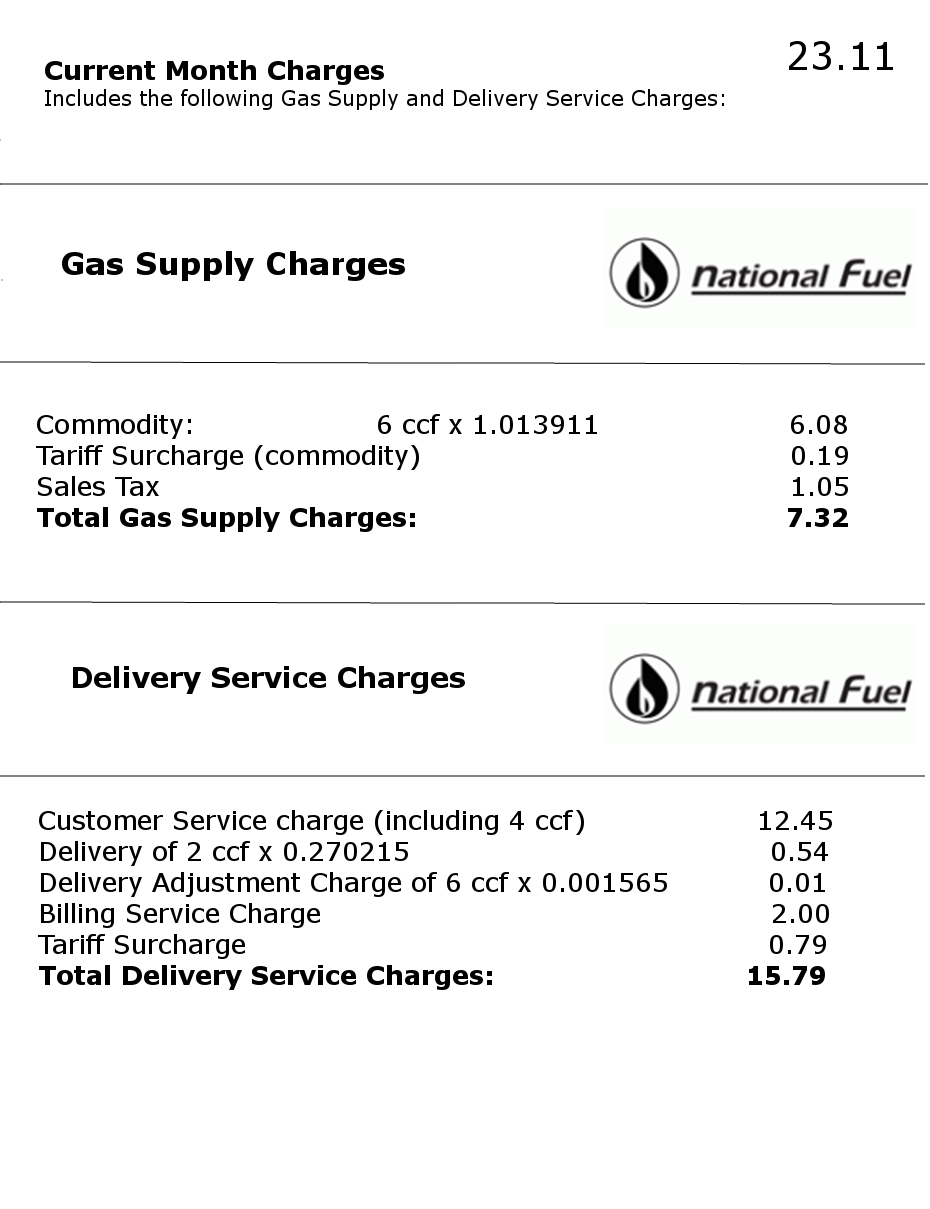
Your delivery and supply charges are normally divided up as pictured. Your bill is measured based on CCF, or one-hundred cubic feet. 1 CCF = 0.1 MCF.
Gas Supply Charges
As you can see on the sample bill to the right, your commodity charges are multiplied by the number of CCF consumed. Both your tariff surcharge and sales tax are at a fixed rate based on the amount of natural gas you consume. Even if you are billed at two rates (example - below 0.4 MCF and above) they are shown added together here.>
Delivery Service Charges
Your delivery charges and your delivery adjusment charges are based on the amount of natural gas you used that month, adjusted for changes based on estimation.