
Bill-template family tree
ConEd family (Consolidated Edison, Inc.)
Con Edison of NY + O&R + RECO + Pike County L&P. Same bill family; line items in similar order.
Avangrid family
NYSEG + RG&E. Different template, different label conventions, different page layout.
Independent NY utilities
National Grid, Central Hudson, PSEG Long Island, each with its own bill design.
If you have read a ConEd bill before, the O&R bill will feel familiar. If you came from upstate (Avangrid territory), the layout looks new.
Page 1 walkthrough: the active bill
Page 1 of the O&R bill is two columns. The left column lists every charge for the current cycle; the right column summarises the account state. Both columns are essential: start at the left and finish at the right.
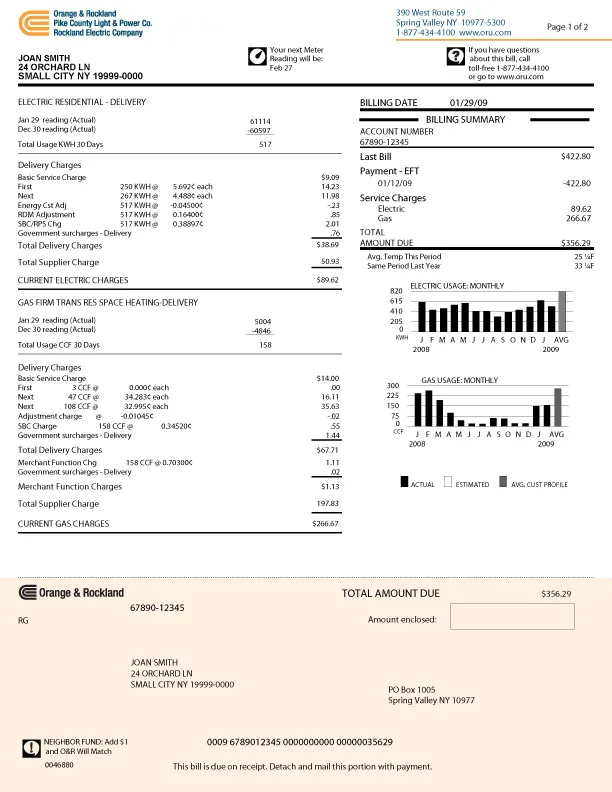
Sample O&R bill, page 1. Tap to open at full size.
Header
Name, service address, next read date
Identifies the account holder and the location at which O&R is delivering power. The next meter reading date tells you when the current billing cycle will close.
Meter reading block
Two readings, one number that matters
Previous read (e.g. Dec 29: 60,597) and current read (e.g. Jan 29: 61,114). The difference is your monthly kWh usage, 517 in this sample. "Actual" means a real read; "Estimated" means O&R guessed and will reconcile next month.
Delivery section
Basic service + delivery + state surcharges
Starts with the flat basic service charge (the customer charge), continues with tiered per-kWh delivery (first 250 kWh, next 250 kWh and so on), and finishes with the state surcharges O&R collects on behalf of New York: SBC, RPS, Energy Cost Adjustment, RDM Adjustment.
Supply section
One number if you have an ESCO; line items if you do not
In the sample bill, the customer has an ESCO (Green Mountain Energy). The supply line shows a single dollar figure ($50.93 for 517 kWh, so 9.85 ¢/kWh effective). Default-service customers see this section broken out: market supply charge + merchant function charge + adjustment lines.
Gas section
Same structure, different unit (CCF)
If you take gas from O&R for "Residential Space Heating", the gas section uses CCF (one hundred cubic feet) instead of kWh. Delivery is tiered (first 3 CCF, next 47 CCF and so on); supply mirrors the electric structure with a market supply charge and merchant function charge.
Right column
Account summary + usage history graph
Account number, total amount due, due date, last payment, current charges. The little bar graph at the bottom shows your usage in this billing cycle versus the same period last year, the single fastest spot to detect a usage anomaly.
The meter math in 30 seconds
The meter section is the most-misread part of every utility bill. The two big numbers are odometer-style cumulative counters; the small number is your monthly usage.
Previous read
60,597
Dec 29 (Actual)
Current read
61,114
Jan 29 (Actual)
This month\'s usage
517 kWh
61,114 − 60,597 = 517. This is the number that drives every per-kWh charge on the bill.
"Estimated" vs "Actual"
An Estimated read means O&R could not physically (or remotely) read the meter that month. The number on the bill is a forecast based on your historical usage. It gets reconciled at the next Actual read: an under-estimate becomes a higher next bill, an over-estimate becomes a credit. If you see two or three Estimated reads in a row, call O&R: there may be a meter-access issue.
Page 2 walkthrough: the supplier detail page
Page 2 is where the ESCO charges (if you have an ESCO) and any rate-comparison information live. Default-service customers see a much shorter page 2, mostly just usage history and regulatory disclosures.
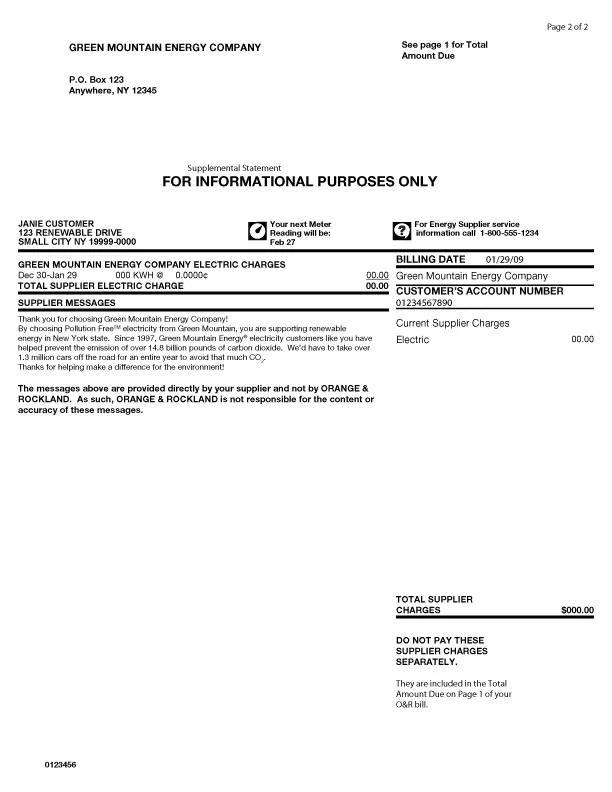
Sample O&R bill, page 2. Tap to open at full size.
Alternate supplier block
Where your ESCO charges land
If you have a non-O&R supplier, this block summarises the supply charges from that company. In the sample, the supplier is Green Mountain Energy; numbers were zeroed for the demo, but a live bill shows the kWh used at the ESCO rate plus any taxes on supply.
Rate comparison disclosure
"Are you saving against default service?"
The April 2026 PSC ESCO settlement strengthened disclosure rules. The supplier section now signals whether the ESCO offer is beating O&R\'s benchmark price or qualifies as a guaranteed-renewable product. If yours says neither, the ESCO is in non-compliance and you can switch back to default service at no charge.
Usage history
12-month bar graph
A 12-bar history of your monthly kWh and CCF. Outliers stand out visually: a January bar twice as tall as last January\'s flags either a cold-snap, a new electric heater, or a meter error.
Regulatory notices
PSC complaint info + safety reminders
The PSC complaint line and the O&R safety reminders (call 811 before you dig, what to do if you smell gas) sit at the bottom. The 811 number is shared with every NY utility; the safety numbers are O&R-specific.
If you have an ESCO, your bill looks slightly different
There are two billing models when you switch to an ESCO on O&R:
- Single-bill model (most common). O&R bills you for both delivery and supply on one statement. The supply line shows the ESCO\'s rate, the supplier name appears in the supply block. This is the sample shown above;
- Dual-bill model. O&R bills only delivery. The ESCO sends you a separate bill for supply. Less common; tends to be offered by larger ESCOs.
Neither model changes the underlying charges. The wires are still owned by O&R; the energy is still purchased on your behalf by whichever party you contracted with. The only difference is which envelope the bill arrives in.
Four bill issues to spot on a sample read
Three Estimated reads in a row
A meter the reader cannot access keeps generating estimates. Eventually a true-up bill arrives with several months of usage at once. Call 1-877-434-4100 and request a meter-access appointment.
Usage 30 percent higher than last year, same month
The 12-month usage graph on page 2 is the fastest detector. Look for a sudden step-change that does not match a known event (new appliance, baby, work-from-home shift).
ESCO supply rate above O&R\'s default
Divide the supplier\'s total $ by the kWh used to get the effective ¢/kWh. Compare against the default supply rate on the bill or on NY PSC Power to Choose. If the ESCO is more expensive, you can switch back to default at no charge.
Government surcharges line jumped
State surcharges (SBC, RPS) reset yearly at the PSC\'s budget approval. A 10 to 20 percent year-on-year shift in this line is normal; bigger jumps merit a check against the state surcharges page.
Frequently asked questions
The label confirms that an O&R meter reader physically (or remotely, through smart-meter telemetry) recorded the meter value on the listed date. The alternative label, "Estimated", means O&R could not get the reading that month and used historical usage to forecast your consumption. Estimated reads are reconciled against the next actual read, so an under-estimate one month often shows up as a higher bill the next.
The two numbers are cumulative meter readings, not monthly usage. Subtracting the earlier from the later gives the kWh used in the billing period. Example: previous read 60,597, current read 61,114, usage 517 kWh. The big numbers are odometer-style counters that increase forever; the small number (the difference) is what you pay for.
Because O&R and ConEd share a parent company (Consolidated Edison, Inc.) and consequently a billing system family. The line-item structure, the supply/delivery split, and the right-column summary mirror the ConEd template. NYSEG (and RG&E) sit under Avangrid, so their bills follow a different template entirely. Knowing your O&R bill teaches you to read a ConEd bill; it does not transfer one-for-one to a NYSEG bill.
CCF stands for one hundred cubic feet, the volumetric unit O&R uses for billing residential natural gas. One CCF roughly equals one therm of heat content, but the conversion drifts a little with gas composition. The bill multiplies your CCF usage by a per-CCF delivery rate plus a per-CCF supply rate (or the ESCO's contract rate if you switched the gas supply too).
In the sample, the customer chose an ESCO for supply (Green Mountain Energy in this case). When you have an ESCO, the supply detail is summarised on the O&R bill but billed separately by the ESCO on page 2 (or on a stand-alone bill, depending on the supplier's billing model). Customers who stay on O&R default service see both halves on page 1, broken out line by line.
Only if you live in northern New Jersey (Bergen, Passaic or Sussex counties). Rockland Electric Company (RECO) is the O&R subsidiary for that NJ footprint, regulated by the NJ BPU. NY customers (Rockland, Orange or Sullivan counties) see "Orange and Rockland Utilities, Inc." on the bill. Both names share a parent and a logo, not a tariff.
Three columns matter. (a) The kWh usage compared to the same month last year, in the bottom-right "usage history" graph on page 1. (b) The delivery total, shaped by the 2025 NY PSC rate case. (c) The supply total, shaped either by O&R default rate moves or by your ESCO contract. Comparing this month's breakdown to the previous month's tells you which lever moved.
Related reading on CallMePower
More U.S. states with energy choice
Same playbook, different utility. Pick another deregulated state to compare utilities, suppliers and switching rules.


