Contact RG&E

Residential customer service

1-800-743-2110

Monday to Friday, 7 a.m. to 7 p.m. ET

Power outage (24/7)

1-800-743-1701

Or report online at rge.com or in the RG&E mobile app.

Gas emergency / odor (24/7)

1-800-743-1702

Smell gas? Leave the building first, then call from outside.

Corporate address

Rochester Gas and Electric
89 East Avenue
Rochester, NY 14649

Utility fact sheet

Legal name
Rochester Gas and Electric Corporation
Type
IOU
Parent
Avangrid Inc.
Ticker
NYSE: AGR
Sister utility
NYSEG
Electric customers
~392,000
Gas customers
~316,000
Retail choice?
Yes (supply only)
Regulator
PSC + FERC
Grid operator
NYISO Zone B

Quick actions

Compare NY suppliers

RG&E in the Avangrid family

RG&E does not stand alone. It is one of two New York utilities run by Avangrid Inc., a US energy company majority-owned by Spain-based Iberdrola. Understanding that parent structure explains why RG&E and NYSEG file joint rate cases yet still bill customers from two separate tariff books.

Iberdrola SA

Madrid-headquartered multinational utility. Holds an ~81.6% stake in Avangrid through Iberdrola USA Networks. Provides corporate engineering, procurement and capital backing.

Avangrid Inc. (NYSE: AGR)

US holding company headquartered in Orange, Connecticut. Owns eight regulated utilities across New York, Maine, Connecticut and Massachusetts, plus a renewables arm. Sets shared executive leadership, IT systems and customer-service platforms.

RG&E and NYSEG

Two separately rate-regulated New York subsidiaries. They share a call center, billing platform, mobile app, and the same joint rate-case filings, but each has its own PSC-approved delivery tariff, customer charge, and territory.

Why this matters for your bill. If you live in Monroe County you are on the RG&E tariff. Cross the border into Wayne County (split between RG&E and NYSEG by town), you may be on the NYSEG tariff with a different delivery rate. Same parent, same call center number, different prices. Always confirm which utility appears on your bill before comparing rates to those of friends and neighbors.

What happened with the 2024 disconnection complaints

Throughout 2024, customer complaints, local-press coverage and elected-official inquiries focused on the volume of disconnection notices being sent in RG&E and NYSEG territories following billing-system changes. The New York Department of Public Service opened a service-quality review and the PSC required Avangrid to file remediation plans covering billing accuracy, complaint handling and disconnection procedures.

For current and prospective RG&E customers the practical takeaway is to know the protections that apply before a balance becomes a shutoff risk:

  • 15-day written notice before shutoff

    Under PSC rules, RG&E must mail a final disconnection notice at least 15 days before service is shut off. If you receive one, call 1-800-743-2110 the same day.

  • Deferred payment agreement (DPA)

    Residential customers have a state-law right to a payment plan, with a down payment of no more than 15% and installments spread over up to 24 months (longer in certain low-income cases).

  • Cold-weather rule

    From November 1 to April 15, RG&E cannot disconnect a residential household whose primary heat depends on the service if any member is over 62, under 18, or has a medical condition (with certification).

  • Medical certificate

    If anyone in the household has a serious illness or uses life-support equipment, a doctor-signed certificate filed with RG&E blocks disconnection for an initial 30 days and can be renewed.

  • HEAP & EAP

    HEAP (NY's branding of federal LIHEAP) can pay part of your heating cost each season; enrollment also unlocks EAP, a monthly bill discount on the RG&E delivery line.

  • PSC complaint hotline

    If you believe a notice or shutoff is in error, file a complaint with the NY DPS at 1-800-342-3355 or via the DPS complaint portal. RG&E cannot disconnect while a PSC complaint is open.

Source: NY PSC Home Energy Fair Practices Act (HEFPA) rules, NY DPS service-quality reviews of NYSEG and RG&E (ongoing as of May 2026). Always check the latest order on DPS Document & Matter Management.

Recent RG&E rate case (PSC Cases 22-E-0317 & 22-G-0318)

The PSC approved a multi-year delivery rate trajectory for RG&E (joint with NYSEG) in 2023, with annual increases phasing in through the 2025-2026 rate year. The settlement set a return on equity of 9.2% and committed Avangrid to bill-relief, service-quality and storm-response improvements.

What changed

  • ·Higher monthly customer charge and per-kWh delivery rate to recover grid-modernization spending.
  • ·Funding for vegetation management and storm-hardening on the rural feeders running across the Finger Lakes.
  • ·Expanded low-income discount budget under the Energy Affordability Program.
  • ·Performance metrics on call-center hold times and billing accuracy, with financial penalties if missed.

What is still phasing in

  • ·The third-year delivery-rate step takes effect in the 2025-2026 rate year.
  • ·Electric-vehicle make-ready incentives for residential and commercial chargers.
  • ·Heat-pump and weatherization rebates under New York's CLCPA framework.
  • ·Advanced metering infrastructure (smart-meter) rollout continuing through 2026.

April 2026 ESCO settlement. The PSC's April 2026 enforcement action against NRG-affiliated ESCOs applies in RG&E territory as well. Affected customers received billing adjustments and a guaranteed savings product was made available at 15% below the utility default rate for one year. See our New York hub for details and eligibility.

Source: NY DPS Case Master records for Cases 22-E-0317 (electric) and 22-G-0318 (gas), April 2026 PSC press release. Figures verified May 2026.

5 things every RG&E customer should know

1

Supply is shoppable, delivery is not

RG&E always delivers the power and gas in its territory. You can switch the supply half of the bill to any PSC-licensed ESCO, but the wires, meter and customer charge stay with RG&E.

2

You sit in NYISO Zone B

Most of RG&E's territory clears in NYISO Zone B (Genesee). Wholesale clearing prices in upstate zones run well below downstate Zone J (NYC), which is the structural reason Rochester supply rates sit below the NY state average.

3

Below the state average

EIA's March 2026 residential price for New York averages 28.55 ¢/kWh. All-in RG&E residential bills run closer to 22-23 ¢/kWh, helped by the dense Rochester service territory and Zone B wholesale clearing.

4

Outage and gas-emergency are different numbers

Power outage 24/7: 1-800-743-1701. Gas emergency 24/7: 1-800-743-1702. Save both. If you smell gas, leave the building first, then call from outside.

5

HEFPA protections are automatic

New York's Home Energy Fair Practices Act gives every residential customer the right to a payment plan, a written disconnection notice, cold-weather protection and a medical certificate. You do not need to ask twice for what the law already grants.

6

Same parent, different prices vs NYSEG

RG&E and NYSEG share the same Avangrid call center and IT systems, but the delivery tariffs are filed separately. Your neighbor across the county line may be on a different rate.

5 expensive RG&E mistakes to avoid

1

Signing a variable-rate ESCO offer without reading the renewal clause

Variable-rate contracts often start as introductory teasers, then float well above the RG&E default rate after month three. The April 2026 PSC enforcement was triggered in part by exactly this pattern. Always check the renewal language and price-after-intro before signing.

2

Ignoring a disconnection notice

The 15-day notice is a deadline, not a warning to file away. Call RG&E the same day and ask for a deferred payment agreement, then check whether you qualify for HEAP. Shutoff fees and reconnection charges add tens of dollars on top of the balance.

3

Forgetting to close the account when you move out

RG&E will keep billing under your name until you submit a move-out request and final read. Use the moving-out guide and provide a forwarding address so the final bill reaches you.

4

Comparing the wrong half of the bill

When you shop an ESCO, you are only choosing the supply price. Comparing the ESCO's per-kWh offer to your total all-in RG&E bill makes the offer look cheaper than it is. Compare supply to supply only.

5

Skipping HEAP because you assume you do not qualify

A four-person household earning up to roughly $80,000 per year qualified for HEAP in the 2025-2026 season. Enrollment also unlocks the monthly EAP discount on the RG&E delivery line. Apply at otda.ny.gov/programs/heap.

Frequently asked questions about RG&E

RG&E is a regulated New York subsidiary of Avangrid Inc. (NYSE: AGR), a US holding company majority-owned by Spain-based Iberdrola. Avangrid also owns NYSEG, Central Maine Power, the United Illuminating Co. and several other Northeast utilities.

No. RG&E and NYSEG are sister utilities under Avangrid. They share executive leadership, the call center number, the mobile app and joint rate-case filings, but their delivery tariffs and customer charges are filed and approved separately by the NY PSC.

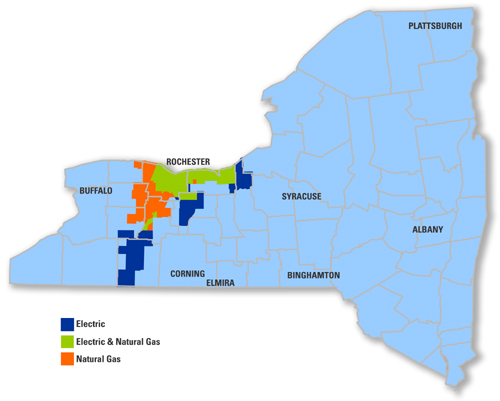
RG&E serves a 9-county region in the Finger Lakes and western New York: Monroe (Rochester), Wayne, Ontario, Yates, Schuyler, Seneca, Steuben, Allegany, Livingston and Genesee. Some Wayne and border-county towns are on NYSEG instead.

New York's cold-weather rule (November 1 to April 15) blocks RG&E from disconnecting a residential household whose primary heat depends on the service if a member is over 62, under 18, or has a certified medical condition. Outside those protected categories, disconnection can still happen, but only after the 15-day written notice required by HEFPA. Filing a PSC complaint on the DPS portal also pauses any pending shutoff.

Throughout 2024, customers and elected officials raised concerns about the volume of disconnection notices following Avangrid billing-system changes. NY DPS opened a service-quality review and the PSC required RG&E and NYSEG to file remediation plans covering billing accuracy, complaint handling and disconnection procedures. The proceedings are public on the DPS Case Master site.

Most of RG&E's territory clears in NYISO Zone B, where wholesale electricity prices sit well below downstate Zone J (New York City). Add a denser, less constrained delivery network and you end up with all-in RG&E residential bills around 22-23 ¢/kWh versus more than 30 ¢/kWh for Con Edison customers.

No. New York has had retail energy choice since 1998. RG&E will always be your delivery company, but you can pick any PSC-licensed ESCO for the supply portion of your bill, or stay on the RG&E default rate, which is reset monthly through auctions.

Two different numbers. Power outage 24/7: 1-800-743-1701. Gas emergency 24/7: 1-800-743-1702. If you smell gas, leave the building before calling. If a power line is on the ground or anyone is hurt, dial 911 first.
18 deregulated jurisdictions

More U.S. states with energy choice

Same playbook, different utility. Pick another deregulated state to compare utilities, suppliers and switching rules.

See all states